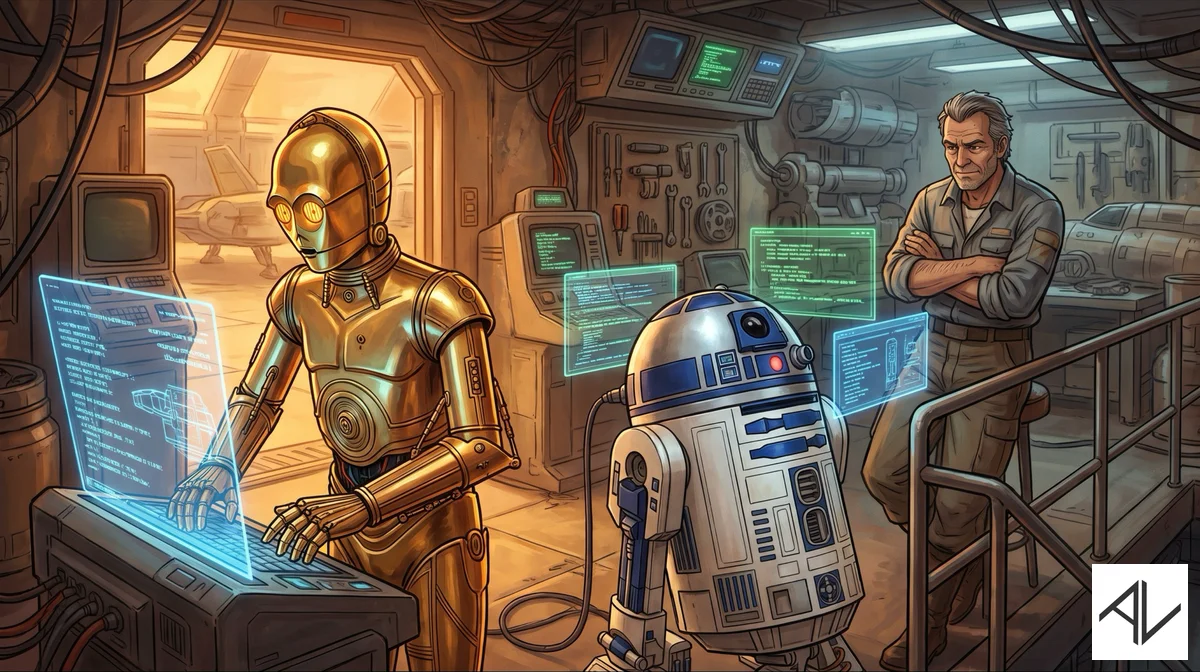
These are not the droids you’re looking for.
I’ve reached the age where people ask me for career advice.
From the younger people — what should they study? Which jobs should they apply for? What will their careers even look like in ten years?
And from the parents — how do they prepare their children for a world where AI will be everywhere?
My sister asked me when she was visiting last month how she should prepare her five-year-old.
I’ve given this a lot of thought over the past couple of months. And the answer right now is this:
AI can DO, but it can’t THINK.
Give a model a task and it will write, code, analyse, summarise and design at a speed and scale that no human can match.
That raw ability to do things has become cheap and universal.
What AI can’t do is think.
It can’t set the direction. It can’t weigh a trade-off with any skin in the game. It doesn’t even know that it’s a pile of text files pretending to be a personality. It can’t look at its own output and know, in its gut, that something is off.
That part remains human.
My favourite way to think about AI as it exists now in LLM form is to think about droids from Star Wars.
They have vast amounts of technical knowledge, are great at performing complex and specific tasks, and sound confident in what they are doing. But you cannot trust them to make gut judgements. They don’t know what “good” or “bad” actually looks like — they only know what “done” and “not done” look like.
Judgement cannot come from a model.
It comes from real-life experience. From having done the work, having made the calls, and having lived with the consequences enough times.
So here’s what I’ve been advising people who ask for career advice.
AI is taking over entry-level work. That’s real, and I won’t pretend otherwise. But it isn’t time to panic yet. You will never be able to out-type the machine, but you can out-experience it.
Your number one goal is to accumulate the one thing that it cannot — real-life experience.
Get your reps in. Take ownership of tasks, projects and real work outcomes. Do enough work to know the difference between good and good enough. And yes, a lot of this now is spending time assessing AI output.
Over time, this experience is what is going to set you apart from others, and make AI more valuable in your hands than in others. Someone still has to steer the AI, and to assess the output.
And if you’re mid-career, here’s the good news: you already have the moat. Twenty years of calls, mistakes and consequences is exactly the thing the machine can’t download.
Are people going to lose their jobs?
On merit? No. A good operator with AI is worth more than ever. The machine needs a skilled operator — it doesn’t run itself.
That isn’t the risk.
The real risk is short-sightedness in management and leadership.
Unfortunately there are business leaders out there who have decided to cut experienced people from their teams because a $200 Claude plan is cheaper… only to discover six months later that someone still needs to operate that $200 Claude plan.
And if it happens to you, you can take heart knowing it’s a failure of management judgement, and not a true assessment of your worth.
The practical implication of this for younger people in or entering the workforce: take whatever opportunities you can get.
Experience is the most important thing right now.
And yes, some of the opportunities won’t let you post on Instagram about your fabulous Starbucks-fuelled office life, or your cool remote-work-from-nature setup, or whatever else it is that constitutes bragging on social media nowadays.
Just remember that it isn’t just you or your generation, it’s always been this way for young people entering the workforce. You take what you can get, and work your way up on your merits.
Now, for my sister’s five-year-old.
If AI research continues down its current path with bigger and better large language models, then not much will change.
(If we have a breakthrough in AI from a different perspective then we will likely reach AGI and the singularity and that’s a whole other discussion.)
My sister is of the opinion that the child should stick to AI-proof industries, and in Australia those are mostly healthcare and trades. Fair enough.
I actually told her that the most important skill to teach them is critical thinking. Technologies change. AI will change. Industries change. But critical thinking is invaluable no matter what they do.
Critical thinking is the ability to think, to judge, to assess. To tell good from bad, and to step up and take responsibility for the outcome if it goes wrong.
By the time her five-year-old enters the workforce, we will probably have JARVIS-level AI assistants or full-on walking-talking robots like C-3PO from Star Wars. They’ll both be able to DO anything, but they still won’t be able to THINK anything.
Courses
I have a range of online courses that teach business people what they need to know about productivity and AI:
1. The AI Playbook
This is my longer premium course on how businesses can deploy AI tools and technology across their processes and teams.
2. The Complete Claude, Claude Code & AI for Work Productivity
A comprehensive course taking you from beginner AI concepts like prompt and context engineering, to cutting-edge AI productivity using terminal-based AI tools like Claude Code for non-coding office work. Usable with ChatGPT, Claude, Gemini and other current LLMs.
3. ChatGPT for Managers
See how AI can solve complex management challenges in less than 30 seconds. Full prompt library and examples included.
4. The AI Agents, Automations and Agentic Workflows Guide
This non-technical course shows business people and non-coders how they can build and use AI agents in ChatGPT and Zapier.
5. Next Level Productivity
A practical, straightforward course that teaches you how to achieve elite-level personal productivity in today’s constantly interrupted world.
That’s it for this week!
— Aaron