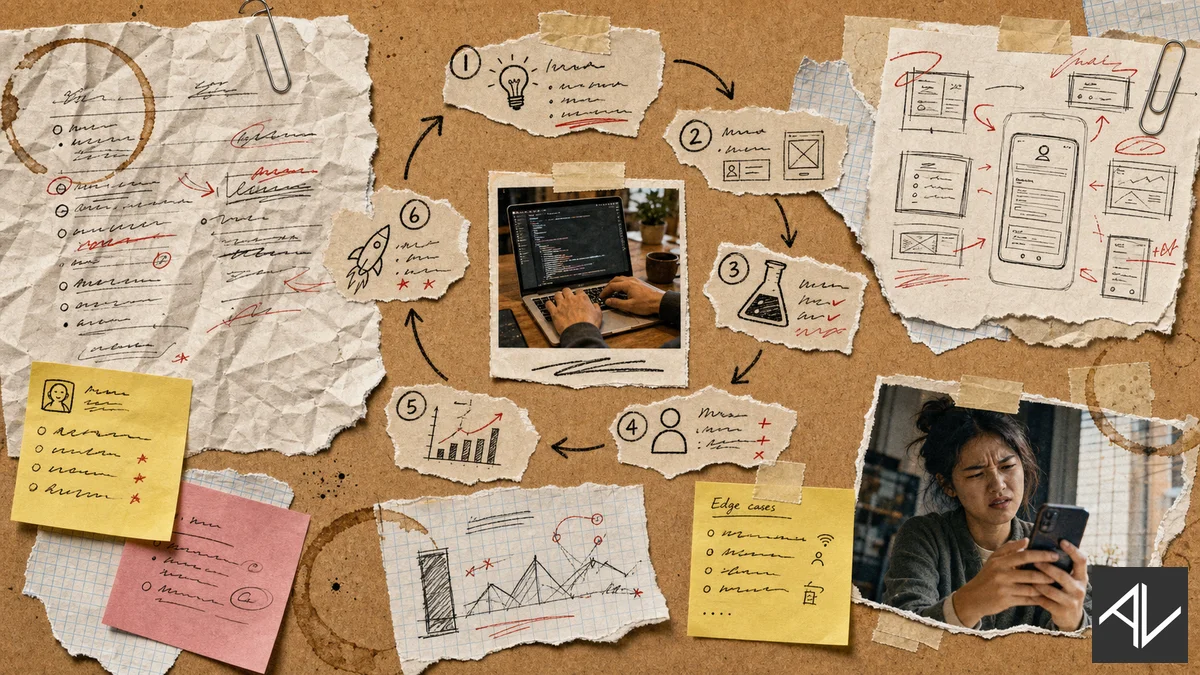
Turns out there’s more to shipping than just prompting AI.
1. The Productivity Formula
There’s a simple formula I keep coming back to: Productivity = Resources x Leverage − Obstacles.
Resources are your time, energy, skills, and money. Obstacles are everything in the way — broken systems, unclear priorities, bad habits, missing information. And leverage is the thing that multiplies what your resources can produce.
AI fits into one slot in that formula:
Leverage.
That’s it.
If your base resources are scattered and your obstacles are stacked high, AI just multiplies the dysfunction. Faster emails don’t help if you’re emailing the wrong people. Automated reports don’t help if nobody reads them.
Before adding AI to any workflow, ask one question: “What obstacle exists here?”
Remove the obstacle first. Then add the leverage.
More on how in my productivity stack guide.
2. The Disappearing Ladder
Worried about AI taking your job?
Don’t be. MIT and NBER tracked 25,000 workers across 7,000 workplaces and found zero effect on earnings or hours worked. For established professionals, AI is a rising tide.
The real threat is quieter. Entry-level tech postings are down up to 67%. 39% of business leaders have already reduced entry-level hiring because of AI.
The ladder is disappearing. Not from the top, but from the bottom.
If you’re a business owner, this is a planning problem with no clear solution at the moment. Who’s in your talent pipeline in three years? Who are you promoting? Where do your future senior hires get the judgment and experience that entry-level roles used to build?
3. One Night Build, Three Days Polish
Building an app overnight with AI is the easy part.
Speccing it out beforehand — what it should do, how it should look, what edge cases to handle — that still takes time. And getting from “it works on my machine” to something you’d actually ship? User testing, design tweaks, copy changes, edge-case fixes. More days.
The build itself? A few hours with the right harness setup.
This is why I still chuckle every time a non-technical person tells me that they “built an app” using one prompt in Claude Code.
AI can easily generate as much code as you ask it for. But the human judgment on either side of it — specifying what to build and deciding when it’s done — is where the real time and experience actually goes.
4. Courses
I have a range of online courses that teach business people what they need to know about productivity and AI:
1. Next Level Productivity
A practical, straightforward course that teaches you how to achieve elite-level personal productivity in today’s constantly interrupted world.
2. The AI Agents, Automations and Agentic Workflows Guide
This non-technical course shows business people and non-coders how they can build and use AI agents in ChatGPT and Zapier.
3. The Complete Claude, Claude Code & AI for Work Productivity
A comprehensive course taking you from beginner AI concepts like prompt and context engineering, to cutting-edge AI productivity using terminal-based AI tools like Claude Code for non-coding office work. Usable with ChatGPT, Claude, Gemini and other current LLMs.
4. The AI Playbook
This is my longer premium course on how businesses can deploy AI tools and technology across their processes and teams.
5. ChatGPT for Managers
See how AI can solve complex management challenges in less than 30 seconds. Full prompt library and examples included.
That’s it for this week!
— Aaron