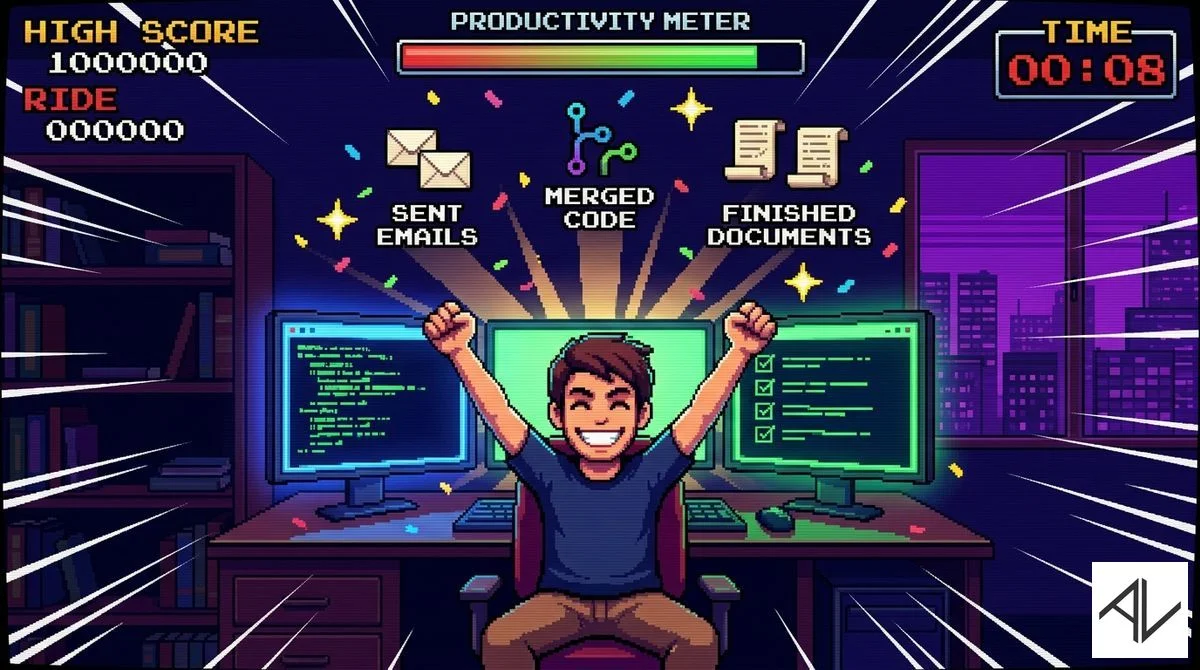
HYPERTASKER vs. BACKLOG. K.O.
1. Hypertasking — The New Way of Working
A few weeks ago I teased the idea of “no XP waste” — filling the gaps between AI prompts with actual work instead of scrolling Instagram.
The full article on hypertasking is now live. Here’s the short version.
The system runs on three segments.
First thing in the morning, you do your deep focus work — no AI, no distractions. Thinking, writing, strategy. The stuff that requires your full brain.
Second, once that window closes, you shift into AI-assisted work for the bulk of the day — prompting, delegating, letting it run.
And in the gaps while AI processes? That’s where you clear the low-level switchable tasks. Emails, admin, calls, errands. The things that don’t require deep thought but still need doing.
People running this are getting 3-5x more done. Not because AI does everything — because they stop wasting the 2-10 minute gaps between prompts.
2. “Isn’t This Just Multitasking?”
No. Multitasking is still bad. The research hasn’t changed.
But hypertasking is structurally different. You switch at self-initiated break points — AI doesn’t interrupt you.
The AI handles the heavy cognitive lifting, so you’re not holding two complex thought processes in your head at once.
You’re delegating, not being interrupted.
You choose when to check on your AI agents, not the other way around.
And when you do switch, it’s to low-effort tasks — you’re never juggling four deep focus items simultaneously.
The research backs this up. Salvucci and Taatgen (2008) call it “threaded cognition” — humans can manage concurrent tasks when those tasks draw on different cognitive resources. Delegation uses one resource, admin uses another, and AI handles execution.
That said, you WILL still experience some multitasking downsides. Which is exactly why this next part matters.
3. The Cognitive Toll Is Real — And the Window Won’t Last
You’re putting out 3-5x what you did before. Your brain is switching contexts, reviewing output, giving feedback, re-prompting — all day.
The non-negotiables are simple but strict.
Work in timeslices — 37 minutes on, 8 minutes off.
Get up and move.
Protect at least an hour of genuine downtime every night, and take half a day off per week.
Sleep, exercise, nutrition — four coffees is not a meal plan.
And know when to slow down. Hypertasking is a systems tool, not a religion.
One more thing worth noting: AI currently has the value of a $250,000/year employee for $100-200/month. That won’t last. Maximise your usage now while it’s practically free.
Full article here. If your productivity fundamentals need work first, grab Next Level Productivity.
4. Courses
I have a range of online courses that teach business people what they need to know about productivity and AI:
1. Next Level Productivity
A practical, straightforward course that teaches you how to achieve elite-level personal productivity in today’s constantly interrupted world.
2. The AI Agents, Automations and Agentic Workflows Guide
This non-technical course shows business people and non-coders how they can build and use AI agents in ChatGPT and Zapier.
3. The Complete Claude, Claude Code & AI for Work Productivity
A comprehensive course taking you from beginner AI concepts like prompt and context engineering, to cutting-edge AI productivity using terminal-based AI tools like Claude Code for non-coding office work. Usable with ChatGPT, Claude, Gemini and other current LLMs.
4. The AI Playbook
This is my longer premium course on how businesses can deploy AI tools and technology across their processes and teams.
5. ChatGPT for Managers
See how AI can solve complex management challenges in less than 30 seconds. Full prompt library and examples included.
That’s it for this week!
— Aaron