
Modern Productivity, circa 2025.
1. Productivity: Life Is Your Biggest Reason to Be Productive. And Your Biggest Obstacle.
Here’s the thing about productivity.
You’re being productive to make money. And you’re making money so you can eventually stop needing to make money. That’s the endgame — acquire enough wealth that work becomes optional, not mandatory.
The more productive you are, the faster you get there.
But here’s the paradox.
You don’t live forever. Every minute spent grinding to accumulate wealth is a minute not spent enjoying life. Time you’ll never get back.
But without that wealth, you’ll never really enjoy life either. You’ll spend your entire existence worried about money, constrained by what you can afford.
So you’re stuck in a balancing act. Work too much now, sacrifice your younger years for a future that might never come. Don’t work enough now, sacrifice your future for present pleasures you can’t afford.
The real skill isn’t just being productive. It’s knowing when to push hard and when to ease off. When to accumulate and when to live.
There’s no single right answer — but there is a wrong one, and it’s not asking yourself this question at all.
Want to maximise your productivity and reach that point sooner? I cover elite-level productivity strategies in Next Level Productivity.
2. Ops: Where Is Your Business Headed?
A quick question worth asking yourself from time to time:
Where is my business actually headed?
Not in the inspirational “mission statement” sense. I mean the realistic, practical sense.
Are you building towards selling it? Planning to run it until you’ve accumulated enough FUM (F* You Money) to retire comfortably? Are you positioning it for acquisition, or is this something you’ll operate for the next 20 years?
Or, and this is worth considering given where we are with technology, is AI going to fundamentally change your business model in ways that make it obsolete? Could automation burn through your competitive advantage? Could the market shift underneath you while you’re focused on quarterly goals?
These aren’t doomsday questions. They’re strategic ones.
Most business owners get so caught up in the day-to-day operations that they never step back to ask the bigger question: what’s the endgame here?
You’re working incredibly hard, solving problems, managing teams, hitting targets — but to what end?
Understanding where you’re headed changes how you operate today. If you’re building to sell, your priorities are different than if you’re building for long-term lifestyle income. If AI is genuinely threatening your business model, you need to be repositioning now, not in three years when it’s too late.
It’s worth asking yourself this question once a quarter. It takes five minutes, and could save you five years of going in the wrong direction.
3. Tech: Most People Are Underutilising AI By About 90%
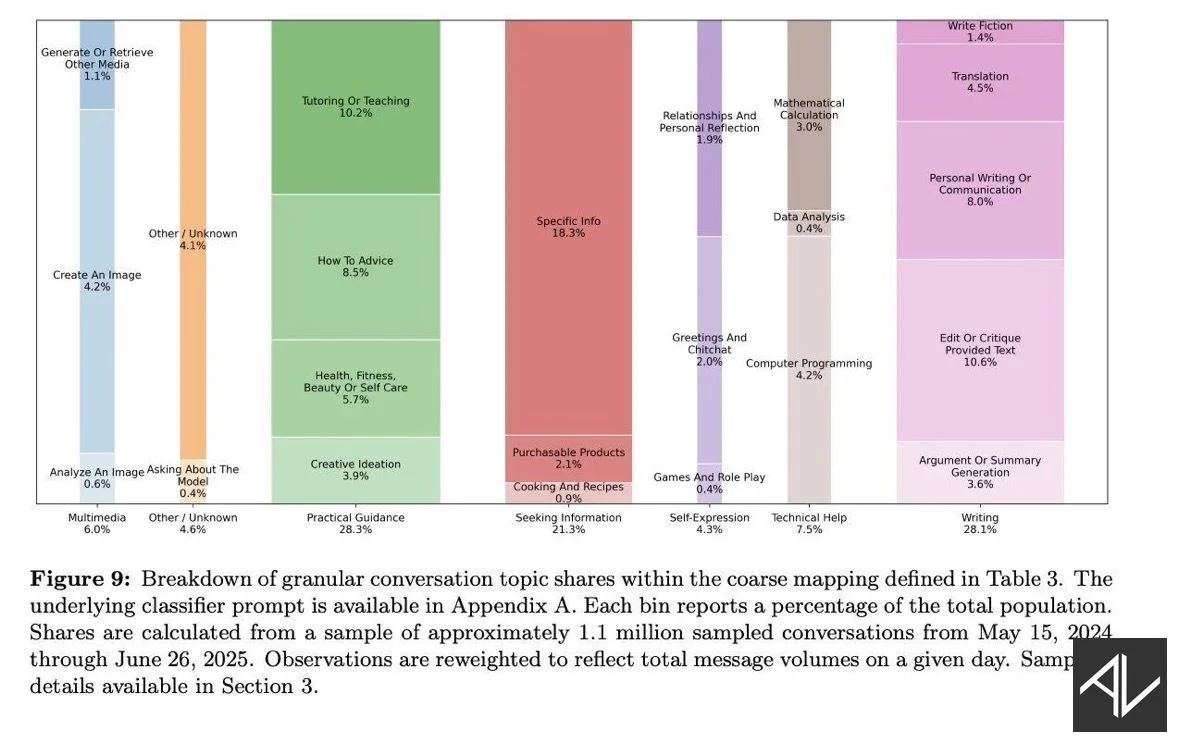
Source: Chatterji, A., Cunningham, T., Deming, D. J., Hitzig, Z., Ong, C., Yan Shan, C., & Wadman, K. (2025). How people use ChatGPT (NBER Working Paper No. 34255). National Bureau of Economic Research. https://doi.org/10.3386/w34255
This chart comes from a recent study done by OpenAI, Duke and Harvard on common AI usage patterns.
The vast majority of people are using AI like Google. Or Grammarly.
That means quick searches, basic proofreading and other surface-level stuff.
That’s not wrong… but it’s leaving about 90% of the value on the table.
Here’s what I mean.
Using ChatGPT to search for a restaurant recommendation? Fine.
Using Claude to channel the nuances of Master P’s rhythms? Great.
But if that’s where your AI usage stops, you’re using a Ferrari to drive to the corner shop.
AI excels at:
- Structuring complex information: Give it messy notes from three different meetings and ask it to create a coherent action plan.
- Drafting first versions: Reports, emails, proposals, presentations.
- Reasoning through problems: Not just answering questions, but helping you think through decisions.
- Automating repetitive workflows: Not one-off tasks, but entire sequences of work.
- Learning and adapting to your style: The more context you give it, the more useful it becomes.
The difference between basic AI usage and advanced AI usage isn’t technical skill. It’s understanding what these tools are actually capable of doing.
Most people ask AI for a quick answer then close the tab. Advanced users are having ongoing conversations, building custom prompts, creating saved workflows, and integrating AI into their actual work processes.
If you’re still using AI like a better search engine, you’re in the majority.
But you’re also missing out.
Want to tap into that other 90%? The Complete Claude, Claude Code & AI for Work Productivity shows you how to use AI properly.
4. Courses
I have a range of online courses that teach business people what they need to know about productivity and AI:
1. Next Level Productivity
A practical, straightforward course that teaches you how to achieve elite-level personal productivity in today’s constantly interrupted world.
2. The AI Agents, Automations and Agentic Workflows Guide
This non-technical course shows business people and non-coders how they can build and use AI agents in ChatGPT and Zapier.
3. The Complete Claude, Claude Code & AI for Work Productivity
A comprehensive course taking you from beginner AI concepts like prompt and context engineering, to cutting-edge AI productivity using terminal-based AI tools like Claude Code for non-coding office work. Usable with ChatGPT, Claude, Gemini and other current LLMs.
4. The AI Playbook
This is my longer premium course on how businesses can deploy AI tools and technology across their processes and teams.
5. ChatGPT for Managers
See how AI can solve complex management challenges in less than 30 seconds. Full prompt library and examples included.
That’s it for this week!
— Aaron