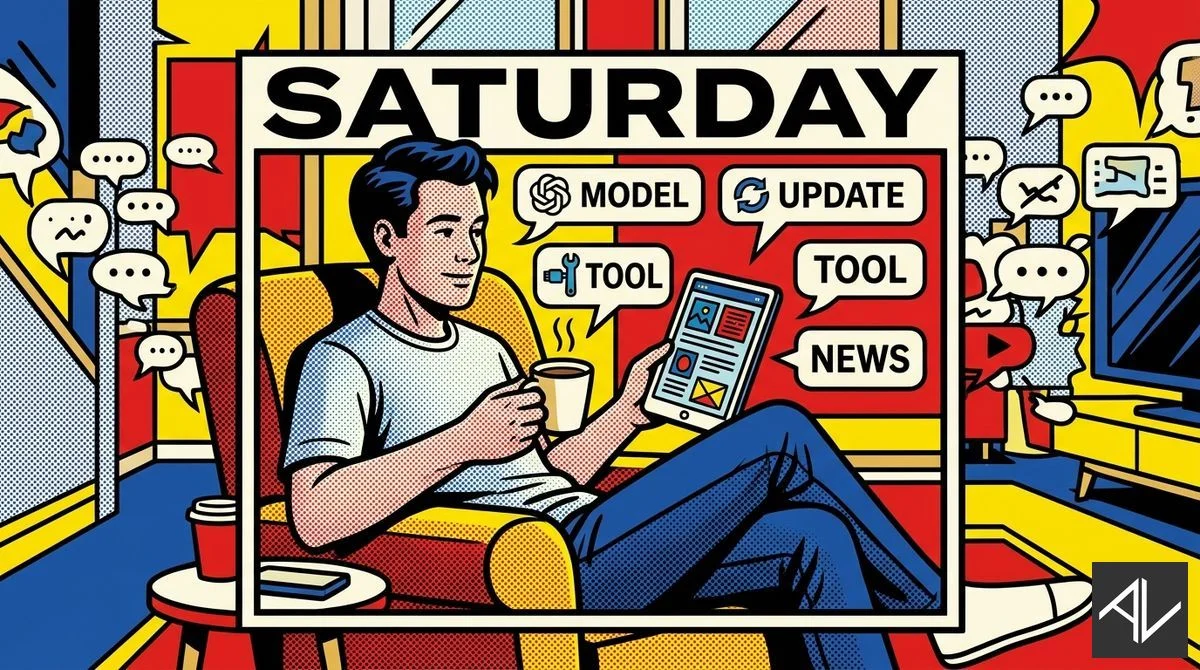
One coffee, one hour, and the whole week of AI news is handled.
1. Don’t Try to Keep Up Daily
There’s a lot happening in AI. Every day. New models, new tools, new workflows, new drama.
Don’t try to keep up with it daily. You’ll never get any work done.
Here’s what I do instead: I block out 1-2 hours every Saturday morning. That’s my AI catch-up window. I have a skill that summarises the articles and links I’ve been sent during the week. I go through that, review my own observations from using AI at work, and tweak my processes.
Then I close the tab and get on with my weekend.
The key is capping the time. AI news is infinite. Your attention isn’t. A weekly batch is enough to stay current without drowning.
If something truly game-changing drops mid-week, you’ll hear about it. Trust that. For everything else, Saturday morning is soon enough.
2. Locus of Control
There’s a psychological concept called locus of control. People with an internal locus believe they influence outcomes. External locus types believe life happens to them.
Internal locus correlates with better career outcomes, health decisions, and general life satisfaction. You’re more likely to act when you believe action matters.
Here’s the AI angle: AI expands your internal locus of control into areas previously outside your individual capacity.
Tasks you couldn’t do alone — build an app, analyse a dataset, create professional designs — you now can. The boundary of “things I can personally control” just got wider.
This isn’t about saving time. It’s about expanding what you can personally make happen.
The people thriving with AI aren’t using it to work less. They’re using it to reach further. More domains. More capability. More control over outcomes that used to require hiring someone else.
3. The Reactionary Trap
There’s a difference between being reactive to incoming requests and having a system that absorbs those requests and schedules them properly.
Reactive mode feels productive. You’re responding. Helping. Clearing things. But you’re letting others set your priorities.
The fix is a capture system that queues requests for review — not immediate action. Everything goes into the inbox. You process it on your schedule. You decide what gets done and when.
With AI, this gets even more powerful. AI is brilliant at ingesting incoming requests, pre-processing them, summarising what matters, and surfacing what you need when you need it. No reaction required. You decide when to engage.
Section 1 was about this applied to AI news. Same principle applies to everything: emails, Slack messages, support tickets, ideas.
Capture. Queue. Process on your terms. That’s how you stay proactive in a reactive world.
4. Courses
I have a range of online courses that teach business people what they need to know about productivity and AI:
1. Next Level Productivity
A practical, straightforward course that teaches you how to achieve elite-level personal productivity in today’s constantly interrupted world.
2. The AI Agents, Automations and Agentic Workflows Guide
This non-technical course shows business people and non-coders how they can build and use AI agents in ChatGPT and Zapier.
3. The Complete Claude, Claude Code & AI for Work Productivity
A comprehensive course taking you from beginner AI concepts like prompt and context engineering, to cutting-edge AI productivity using terminal-based AI tools like Claude Code for non-coding office work. Usable with ChatGPT, Claude, Gemini and other current LLMs.
4. The AI Playbook
This is my longer premium course on how businesses can deploy AI tools and technology across their processes and teams.
5. ChatGPT for Managers
See how AI can solve complex management challenges in less than 30 seconds. Full prompt library and examples included.
That’s it for this week!
— Aaron