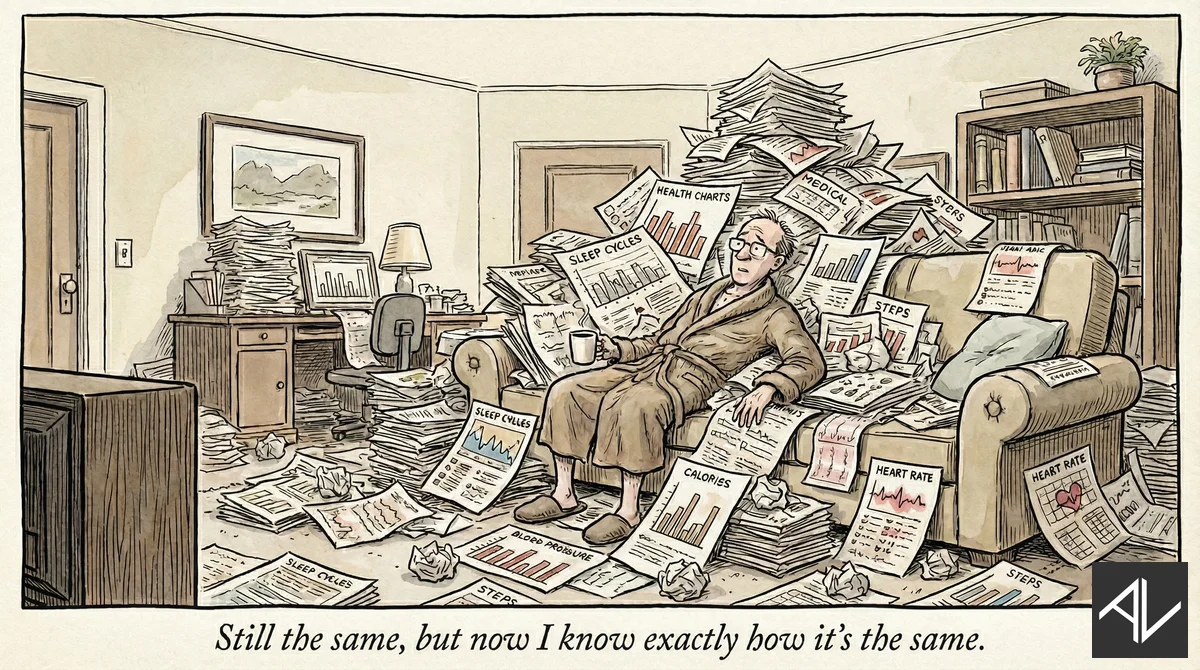
Your Oura ring can’t fix your sleep for you.
1. Productivity: Don’t Track If You Don’t Improve
People love tracking things. Sleep scores. Steps walked. Deep work hours.
The data feels productive, like you’re doing something meaningful.
But tracking without action is just data collection.
I wear an Apple Watch to sleep every night. But to put the data into action, I needed a different checklist of sleep environment factors I could test — different temperature, different pillows, different bedding, sleep times and so on. Without that, it wouldn’t matter how many nights I scored “Excellent” or “High” or even “Poor” on my sleep score - that’s just data.
The point of tracking is to spot patterns, run experiments, and make changes. If you’re not going to do anything with the data, stop collecting it.
2. Ops: Going Solo to Team Means Systems
When you’re a founder starting out solo, you can do things however you want. Your workflows, your shortcuts, your way of thinking about problems — it’s all in your head.
The moment you bring on even one other person? Everything changes.
I recently taught a friend about agile development and writing user stories. His first question was — “Why do I have to do it this way? Usually I just have an idea in my head of what I want to create and just start and jump around until it’s done.”
And that’s exactly why you can’t keep working the same way you did solo when you have a team. Your team isn’t inside your head — they are out in the real world, working on things independently for you.
Here’s what needs to happen:
- Document your core processes. SOPs are law.
- Create communication protocols. When do people check in? Where do updates go?
- Establish decision-making frameworks. Who decides what?
The hardest part is accepting that your team won’t do things exactly the way you would. And that’s fine.
Systems scale, what goes on in your head doesn’t.
3. Tech: Adversarial AIs
I believe that in 2026 we are going to see the rise of adversarial AIs.
And no, I don’t mean that Skynet is finally coming for us.
I mean that smart AI users will be pitting AIs against each other as a way to prompt them to produce better output.
Here’s a simple example:
- AI 1: Draft the content.
- AI 2: Act as a sceptical reader and identify weak points.
- AI 1: Revise based on feedback.
- AI 2: Critique again.
Rinse and repeat over multiple iterations.
One AI drafts. Another critiques. They challenge each other, and you end up with something far better than any single AI could produce.
Unlike human teams, AI teams don’t have scheduling conflicts or personality clashes. They don’t take it personally when they receive blunt feedback on their output.
If you aren’t using adversarial AIs yet, start!
4. Courses
I have a range of online courses that teach business people what they need to know about productivity and AI:
1. Next Level Productivity
A practical, straightforward course that teaches you how to achieve elite-level personal productivity in today’s constantly interrupted world.
2. The AI Agents, Automations and Agentic Workflows Guide
This non-technical course shows business people and non-coders how they can build and use AI agents in ChatGPT and Zapier.
3. The Complete Claude, Claude Code & AI for Work Productivity
A comprehensive course taking you from beginner AI concepts like prompt and context engineering, to cutting-edge AI productivity using terminal-based AI tools like Claude Code for non-coding office work. Usable with ChatGPT, Claude, Gemini and other current LLMs.
4. The AI Playbook
This is my longer premium course on how businesses can deploy AI tools and technology across their processes and teams.
5. ChatGPT for Managers
See how AI can solve complex management challenges in less than 30 seconds. Full prompt library and examples included.
That’s it for this week!
— Aaron